How should the VC historical PE ratio be determined?
Realizing that PE stands for Price to Earnings ratio, we need two values to compute it: stock price and earnings per share. The stock price at any given date is a known historical value, but what about the earnings number to use?
✔️Accepted answer:
There are a number of different approaches when it comes to calculating a historical PE ratio for a company like Visteon. We like to take our measurements on each of the past quarterly earnings reports. That only leaves the question of whether the earnings number at that quarterly report should be used on an annualized basis, or some other method. We approach this question using three different methods, on this VC Historical PE Ratio page.
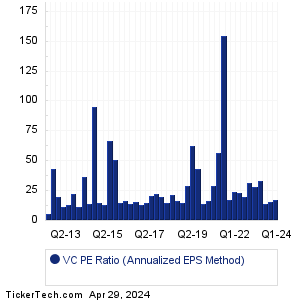
What is the average historical PE for VC based on annualized quarterly earnings?
As we look back through earnings history, what is the resulting PE calculation if at each measurement period we use that quarter's earnings result annualized?
✔️Accepted answer:
The VC historical PE ratio using the annualized quarterly earnings method works out to 28.3.
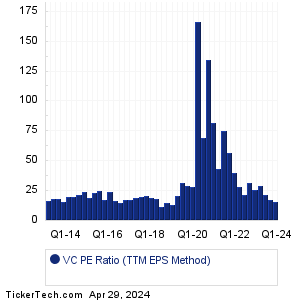
What is the average historical PE for VC based on trailing twelve month earnings?
As we look back through earnings history, what is the resulting PE calculation if at each measurement period we use the trailing twelve months combined earnings result in the calculation?
✔️Accepted answer:
The VC historical PE ratio using the TTM earnings method works out to 32.1.
What is the average historical PE for VC based on median TTM earnings?
As we look back through earnings history, what is the resulting PE calculation if at each measurement period we use the median earnings over the trailing twelve months and annualize that median result in the calculation?
✔️Accepted answer:
The VC historical PE ratio using the annualized median TTM earnings method works out to 6.32.
On this page we presented the
VC Historical PE Ratio information for Visteon' stock.
The average VC historical PE based on using the annualized quarterly earnings result at each measurement period (for the "E" in the PE calculation; and the closing price on earnings date as the "P") is 28.3. Meanwhile, using the trailing twelve month (TTM) quarterly earnings result as our method of calculation the "E" value at each measurement period, the average VC historical PE based on this TTM earnings result method is 32.1. Note: any PE calculations involving negative earnings were discarded as not meaningful.
Let's now compare this VC historical PE result, against the recent PE: when this page was posted on 4/10/2024, the most recent closing price for VC had been 113.52, and the most recent quarterly earnings result, annualized, was 7.64. Meanwhile, the most recent TTM earnings summed to 6.69. From these numbers, we calculate the recent VC PE on 4/10/2024 based on annualized quarterly EPS was 14.9. Based on VC's history, that recent PE is low relative to the historical average, with the recent PE 47.3% lower than the historical average PE across our data set for Visteon. Looking at the recent VC PE on 4/10/2024 based on TTM EPS, we calculate the ratio at 17.0. Based on VC's history, that recent PE is low relative to the historical average, with the recent PE 47.0% lower than the average PE across our Visteon data set with TTM EPS used in the calculation at each period.
Another interesting VC historical PE Ratio calculation we look at is to take the
median earnings per share of the last four quarters for VC, and then annualize the resulting value... with that annualized number then being used in the PE calculation. To walk through this math for VC, we start with the past four EPS numbers and we first sort them from lowest to highest: 1.18, 1.25, 1.91, and 2.35. We then toss out the highest and lowest result, and then take the average of those two middle numbers — 1.25 and 1.91 — which gives us the median of 1.58. Basically the way to think about this 1.58 number is this: for the trailing four earnings reports, 1.58 marks the "middle ground" number where VC has reported a value
higher than 1.58 half the time, and has reported a value
lower than 1.58 half the time. Annualizing that median value then gets us to 6.32/share, which we use as the denominator in our next PE calculation. With 113.52 as the numerator (as of 4/10/2024), the calculation is then 113.52 / 6.32 =
18.0 as the VC PE ratio as of 4/10/2024, based on that annualized median value we calculated.
For self directed investors doing their due diligence on VC or any other given stock, valuation analysis for VC
can greatly benefit from studying the past earnings and resulting PE calculations. This exercise can help inform an analysis
as to whether the past earnings trajectory and current versus historical PE ratios justify the current stock value.
That's why we bring you
HistoricalPERatio.com to make it easy for investors to investigate
Visteon PE history or the past PE information for any stock in our coverage universe.
And in your continued research we hope you will be sure to check out the further links included for earnings
surprises history (beat/miss data) as well as next earnings dates for VC. Thanks for visiting, and the next
time you need to research
VC Historical PE Ratio or the ratio for another stock, we hope you'll think of our site, as your
go-to historical PE ratio research resource of choice.

 This VC PE ratio history page last updated 4/11/2024

 Free VC Email Alerts:

