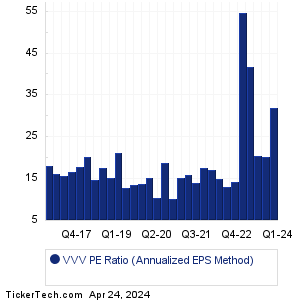
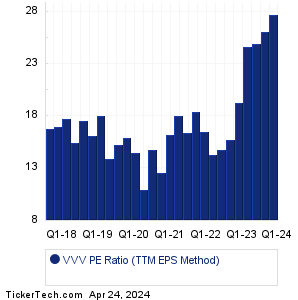
VVV Historical PE Ratio image   This VVV PE ratio history page last updated 3/7/2026

VVV Historical PE Ratio Notes

— Valvoline Inc. (ticker: VVV) is a leading provider of automotive services & products, specializing in quick oil changes, preventive maintenance, & other vehicle care services primarily through its network of company-owned & franchised Valvoline Instant Oil Change locations. The company focuses on the ȁcdo-it-for-meȁd market, serving both consumer & commercial customers with a strong brand recognized for convenience and quality. As you review VVV's historical price-to-earnings (PE) ratio, it's important to understand that its business model—anchored in recurring, non-cyclical maintenance services—tends to produce steady, predictable cash flows & earnings. This stability often leads to a premium PE ratio compared to more volatile auto parts or manufacturing businesses. However, the PE has also reflected factors such as expansion pace, competitive pressures, and economic slowdowns (which can impact miles driven). M&A activity, changes in consumer routines, and disruptions such as the COVID-19 pandemic have also contributed to swings in earnings, thus affecting the PE ratio over time. When analyzing VVV's historical PE, consider how shifts in service demand, margin changes, or macroeconomic conditions have influenced both the numerator (stock price) & denominator (earnings) in those periods.
VVV Historical PE Ratio Chart
PeriodPriceAdj. EPSAnnualizedPE
Q1 2026
2/4/2026
35.600.371.4824.1
Q4 2025
11/19/2025
30.640.451.8017.0
Q3 2025
8/6/2025
37.910.471.8820.2
Q2 2025
5/8/2025
33.900.341.3624.9
Q1 2025
2/6/2025
39.580.321.2830.9
Q4 2024
11/19/2024
38.650.461.8421.0
Q3 2024
8/7/2024
38.640.451.8021.5
Q2 2024
5/8/2024
42.190.371.4828.5
Q1 2024
2/6/2024
37.060.291.1631.9
Q4 2023
11/9/2023
31.610.391.5620.3
Q3 2023
8/9/2023
35.090.431.7220.4
Q2 2023
5/10/2023
38.450.230.9241.8
Q1 2023
2/7/2023
34.990.160.6454.7
Q4 2022
11/15/2022
33.530.592.3614.2
Q3 2022
8/3/2022
30.250.582.3213.0
Q2 2022
5/9/2022
28.790.481.9215.0
Q1 2022
2/8/2022
32.800.481.9217.1
Q4 2021
11/3/2021
35.340.502.0017.7
Q3 2021
8/4/2021
30.760.552.2014.0
Q2 2021
4/28/2021
29.060.461.8415.8
Q1 2021
2/3/2021
25.000.411.6415.2
Q4 2020
10/28/2020
18.670.461.8410.1
Q3 2020
8/3/2020
21.070.281.1218.8
Q2 2020
5/6/2020
16.430.391.5610.5
Q1 2020
2/3/2020
21.380.351.4015.3
Q4 2019
11/6/2019
22.120.401.6013.8
Q3 2019
7/31/2019
20.190.371.4813.6
Q2 2019
5/1/2019
17.830.351.4012.7
Q1 2019
2/6/2019
22.870.271.0821.2
Q4 2018
11/5/2018
20.790.341.3615.3
Q3 2018
8/1/2018
22.430.321.2817.5
Q2 2018
5/2/2018
20.020.341.3614.7
Q1 2018
2/7/2018
23.600.291.1620.3
Q4 2017
11/8/2017
23.640.331.3217.9
Q3 2017
8/1/2017
22.720.341.3616.7
Q2 2017
4/25/2017
23.280.371.4815.7
Q1 2017
1/26/2017
22.490.351.4016.1
Q4 2016
11/8/2016
21.030.291.1618.1
VVV PE History Chart
PeriodPriceAdj. EPSTTMPE
Q1 2026
2/4/2026
35.600.371.6321.8
Q4 2025
11/19/2025
30.640.451.5819.4
Q3 2025
8/6/2025
37.910.471.5923.8
Q2 2025
5/8/2025
33.900.341.5721.6
Q1 2025
2/6/2025
39.580.321.6024.7
Q4 2024
11/19/2024
38.650.461.5724.6
Q3 2024
8/7/2024
38.640.451.5025.8
Q2 2024
5/8/2024
42.190.371.4828.5
Q1 2024
2/6/2024
37.060.291.3427.7
Q4 2023
11/9/2023
31.610.391.2126.1
Q3 2023
8/9/2023
35.090.431.4124.9
Q2 2023
5/10/2023
38.450.231.5624.6
Q1 2023
2/7/2023
34.990.161.8119.3
Q4 2022
11/15/2022
33.530.592.1315.7
Q3 2022
8/3/2022
30.250.582.0414.8
Q2 2022
5/9/2022
28.790.482.0114.3
Q1 2022
2/8/2022
32.800.481.9916.5
Q4 2021
11/3/2021
35.340.501.9218.4
Q3 2021
8/4/2021
30.760.551.8816.4
Q2 2021
4/28/2021
29.060.461.6118.0
Q1 2021
2/3/2021
25.000.411.5416.2
Q4 2020
10/28/2020
18.670.461.4812.6
Q3 2020
8/3/2020
21.070.281.4214.8
Q2 2020
5/6/2020
16.430.391.5110.9
Q1 2020
2/3/2020
21.380.351.4714.5
Q4 2019
11/6/2019
22.120.401.3915.9
Q3 2019
7/31/2019
20.190.371.3315.2
Q2 2019
5/1/2019
17.830.351.2813.9
Q1 2019
2/6/2019
22.870.271.2718.0
Q4 2018
11/5/2018
20.790.341.2916.1
Q3 2018
8/1/2018
22.430.321.2817.5
Q2 2018
5/2/2018
20.020.341.3015.4
Q1 2018
2/7/2018
23.600.291.3317.7
Q4 2017
11/8/2017
23.640.331.3917.0
Q3 2017
8/1/2017
22.720.341.3516.8
Q2 2017
4/25/2017
23.280.37NANA
Q1 2017
1/26/2017
22.490.35NANA
Q4 2016
11/8/2016
21.030.29NANA
Quotes delayed 20 minutes

Email EnvelopeFree VVV Email Alerts:
Get Dividend Alerts
Get SEC Filing Alerts
10 Most Oversold S&P 500 Stocks
10 Most Overbought S&P 500 Stocks
10 ETFs With Stocks Insiders Are Buying
10 ETFs With Most Upside To Targets
The DividendRank Top 25
Warren Buffett Dividend Stocks
10 Cheap Dividend Stocks Under $10
10 Top DividendRank'ed Energy Stocks
The 10 Highest Yielding Preferred Stocks
The 15 Most Active S&P Call & Put Options
Valvoline (VVV) is categorized under the Services sector; to help you further research PE history across stocks, below are some other companies in the same sector:

VWTR Historical PE Ratio
W Historical PE Ratio
WBA Historical PE Ratio
WBD Historical PE Ratio
WEBR Historical PE Ratio
WEN Historical PE Ratio
WEYS Historical PE Ratio
WH Historical PE Ratio
WINA Historical PE Ratio
WING Historical PE Ratio
How should the VVV historical PE ratio be determined?
Realizing that PE stands for Price to Earnings ratio, we need two values to compute it: stock price and earnings per share. The stock price at any given date is a known historical value, but what about the earnings number to use?

✔️Accepted answer: There are a number of different approaches when it comes to calculating a historical PE ratio for a company like Valvoline. We like to take our measurements on each of the past quarterly earnings reports. That only leaves the question of whether the earnings number at that quarterly report should be used on an annualized basis, or some other method. We approach this question using three different methods, on this VVV Historical PE Ratio page.

What is the average historical PE for VVV based on annualized quarterly earnings?
As we look back through earnings history, what is the resulting PE calculation if at each measurement period we use that quarter's earnings result annualized?

✔️Accepted answer: The VVV historical PE ratio using the annualized quarterly earnings method works out to 19.7.

What is the average historical PE for VVV based on trailing twelve month earnings?
As we look back through earnings history, what is the resulting PE calculation if at each measurement period we use the trailing twelve months combined earnings result in the calculation?

✔️Accepted answer: The VVV historical PE ratio using the TTM earnings method works out to 18.8.

What is the average historical PE for VVV based on median TTM earnings?
As we look back through earnings history, what is the resulting PE calculation if at each measurement period we use the median earnings over the trailing twelve months and annualize that median result in the calculation?

✔️Accepted answer: The VVV historical PE ratio using the annualized median TTM earnings method works out to 1.64.

On this page we presented the VVV Historical PE Ratio information for Valvoline' stock. The average VVV historical PE based on using the annualized quarterly earnings result at each measurement period (for the "E" in the PE calculation; and the closing price on earnings date as the "P") is 19.7. Meanwhile, using the trailing twelve month (TTM) quarterly earnings result as our method of calculation the "E" value at each measurement period, the average VVV historical PE based on this TTM earnings result method is 18.8.

Let's now compare this VVV historical PE result, against the recent PE: when this page was posted on 3/6/2026, the most recent closing price for VVV had been 35.27, and the most recent quarterly earnings result, annualized, was 1.48. Meanwhile, the most recent TTM earnings summed to 1.63. From these numbers, we calculate the recent VVV PE on 3/6/2026 based on annualized quarterly EPS was 23.8. Based on VVV's history, that recent PE is elevated relative to the historical average, with the recent PE 20.8% higher than the historical average PE across our data set for Valvoline. Looking at the recent VVV PE on 3/6/2026 based on TTM EPS, we calculate the ratio at 21.6. Based on VVV's history, that recent PE is elevated relative to the historical average, with the recent PE 14.9% higher than the historical average PE across our Valvoline data set with TTM EPS used in the calculation at each period.

Another interesting VVV historical PE Ratio calculation we look at is to take the median earnings per share of the last four quarters for VVV, and then annualize the resulting value... with that annualized number then being used in the PE calculation. To walk through this math for VVV, we start with the past four EPS numbers and we first sort them from lowest to highest: 0.34, 0.37, 0.45, and 0.47. We then toss out the highest and lowest result, and then take the average of those two middle numbers — 0.37 and 0.45 — which gives us the median of 0.41. Basically the way to think about this 0.41 number is this: for the trailing four earnings reports, 0.41 marks the "middle ground" number where VVV has reported a value higher than 0.41 half the time, and has reported a value lower than 0.41 half the time. Annualizing that median value then gets us to 1.64/share, which we use as the denominator in our next PE calculation. With 35.27 as the numerator (as of 3/6/2026), the calculation is then 35.27 / 1.64 = 21.5 as the VVV PE ratio as of 3/6/2026, based on that annualized median value we calculated.

For self directed investors doing their due diligence on VVV or any other given stock, valuation analysis for VVV can greatly benefit from studying the past earnings and resulting PE calculations. This exercise can help inform an analysis as to whether the past earnings trajectory and current versus historical PE ratios justify the current stock value.

That's why we bring you HistoricalPERatio.com to make it easy for investors to investigate Valvoline PE history or the past PE information for any stock in our coverage universe. And in your continued research we hope you will be sure to check out the further links included for earnings surprises history (beat/miss data) as well as next earnings dates for VVV. Thanks for visiting, and the next time you need to research VVV Historical PE Ratio or the ratio for another stock, we hope you'll think of our site, as your go-to historical PE ratio research resource of choice.

Also recommended: GEL shares outstanding history, Institutional Holders of RPI, IVOG Videos.


VVV Historical PE Ratio | www.HistoricalPERatio.com | Copyright © 2020 - 2026, All Rights Reserved

Nothing in HistoricalPERatio.com is intended to be investment advice, nor does it represent the opinion of, counsel from, or recommendations by BNK Invest Inc. or any of its affiliates, subsidiaries or partners. None of the information contained herein constitutes a recommendation that any particular security, portfolio, transaction, or investment strategy is suitable for any specific person. All viewers agree that under no circumstances will BNK Invest, Inc,. its subsidiaries, partners, officers, employees, affiliates, or agents be held liable for any loss or damage caused by your reliance on information obtained. By visiting, using or viewing this site, you agree to the following Full Disclaimer & Terms of Use and Privacy Policy. Video widget and market videos powered by Market News Video. Quote and option data delayed at least 15 minutes; stock quote data powered by Ticker Technologies, and Mergent.
X
Wait! Don't leave yet.
Want to receive our latest research absolutely free?


Click the button below for your complimentary copy of Your Early Retirement Portfolio: Dividends Up to 8.2%—Every Month—Forever.

You'll discover the details on 4 stocks and funds that pay you massive dividends as high as 8.2%.